
Marble vs Corian vs Wood vs HDHMR: Which Mandir Material is Right for You?
When families come to us at Make My Mandir, the question we hear most often after "how much?" is "which material is best?" There is no single right answer — but there is a right answer for YOUR home, lifestyle, budget, and ritual style. Here is the honest comparison.
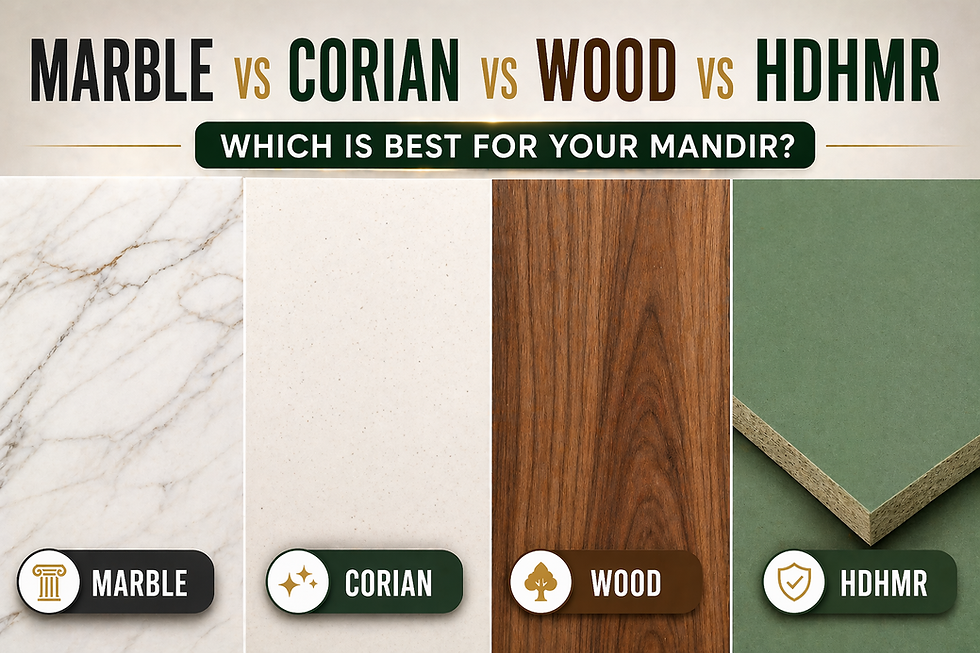
Marble — timeless, sacred, generational
Best for: traditional households, bungalows with a dedicated puja room, families who see the mandir as a multi-generational heirloom.
Varieties we work with: Makrana (Rajasthan) for pure white brilliance, Vietnam Marble for affordability, Statuario for bold grey veining, Indian Green for contrast accents.
Pros: Ages beautifully, gains patina over time, holds sacred significance in Hindu/Jain tradition, flame and heat resistant, appreciates as an heirloom
Cons: Heavy (may need floor reinforcement for Mandir Rooms), can stain if oil/kumkum is not cleaned quickly, slight colour variation from sample to final slab
Maintenance: Wipe daily with a soft dry cloth. Apply marble sealant every 12–18 months. Avoid abrasive cleaners or acidic liquids (lemon, vinegar).
Approximate cost: ₹1.8 lakh for a 3×2×6 ft Open Cabinet Mandir. Mandir Rooms start from ₹8 lakh.
Corian / Solid Surface — modern, seamless, low-maintenance
Best for: contemporary apartments, modular kitchens, homeowners who want a clean, minimalist aesthetic with zero staining worry.
Corian (or similar acrylic solid-surface composites from DuPont, LG Hi-Macs, Samsung Staron) is a modern marvel for mandir design. It's non-porous, seamless, can be moulded into curves, backlit for a divine glow, and comes in hundreds of colours. It has become the signature material of modern mandirs for a reason.
Pros: Seamless joints, stain-resistant, can be backlit for a divine glow, easily repaired if scratched, integrates beautifully with modular interiors
Cons: Less traditional feel than marble, can scorch if diyas are placed directly without a protective tray, man-made rather than natural
Maintenance: The easiest of all our materials — wipe with a damp cloth, soap and water for any residue. Any shallow scratches can be buffed out with fine sandpaper on-site.
Approximate cost: ₹1.62 lakh for a 3×2×6 ft Open Cabinet Mandir. Mandir Rooms start from ₹6 lakh.
Solid Wood (Teak, Sheesham, Sagwan) — warm, heirloom, characterful
Best for: traditional Indian homes, families with wooden flooring or furniture, those who want the mandir to feel alive and organic.
There is nothing quite like the warmth of natural wood. Each piece has its own grain pattern, so no two wooden mandirs are ever exactly alike. Properly maintained, a solid wood mandir will outlive its original owners and pass to the next generation with even more character.
Pros: Warm, organic, every piece unique, accepts intricate hand-carving beautifully, naturally heat-tolerant for diyas, develops character with age
Cons: Can expand/contract with humidity changes, requires polish refresh every 2–3 years, susceptible to termites in some regions (treated wood solves this)
Maintenance: Wipe gently with a soft dry cloth. Polish annually with beeswax or wood conditioner. Keep away from direct sunlight to prevent fading.
Approximate cost: ₹1.44 lakh for a 3×2×6 ft Open Cabinet Mandir in teak. Premium carved variants go significantly higher.
HDHMR + Duco — premium finish at accessible prices
Best for: first-time mandir buyers, young families, rental apartments, homes where budget matters but quality can't be compromised.
HDHMR (High Density High Moisture Resistant) is an engineered board that forms the base, then finished with Duco — the same high-gloss automotive paint used on luxury cars. The result is a mandir that looks as premium as solid surface at roughly 70% of the cost, in literally any colour you can imagine.
Pros: Available in literally any colour, glossy mirror-like finish, lighter than solid wood or marble, moisture-resistant, great for younger designs
Cons: Scratches show more on glossy finish (can be buffed), considered a mid-tier material by traditional buyers, repainting after 8–10 years may be needed
Maintenance: Microfibre cloth for daily dusting. Very mild soap solution for deeper cleans. Never use abrasive scrubs on Duco finish.
Approximate cost: ₹1.15 lakh for a 3×2×6 ft Open Cabinet Mandir. Excellent value for money.
The honest, no-nonsense comparison
Choose Marble if: tradition matters most, you have a bungalow or villa, and you see the mandir as your life's heirloom investment.
Choose Corian if: you live in a modern apartment, want minimal maintenance, love clean lines and backlit designs, and value a 'forever-new' aesthetic.
Choose Solid Wood if: warmth and natural character speak to you, you already have wooden interiors, and you want the mandir to feel alive.
Choose HDHMR+Duco if: budget is a real consideration, you want vibrant colour options (saffron, ivory, royal blue), or you're building your first mandir and plan to upgrade later.
At Make My Mandir we work with all four materials daily. We never push you toward the most expensive option — our job is to understand your home, your rituals, your budget, and recommend honestly. Many of our most beautiful projects have been in Solid Surfaces
for young families. Many of our most breathtaking ones have been in simple teak with delicate carving. There's no hierarchy of 'better' materials — just better fits.
Ready to explore materials in person?
We keep physical samples of all four materials at our Pune studio. Visit us to see, touch, and compare — or WhatsApp us at +91 77679 62441 to schedule a free consultation. Share photos of your existing interiors and we'll recommend the materials that complement your home best.
— The Make My Mandir Team, Pune


Comments